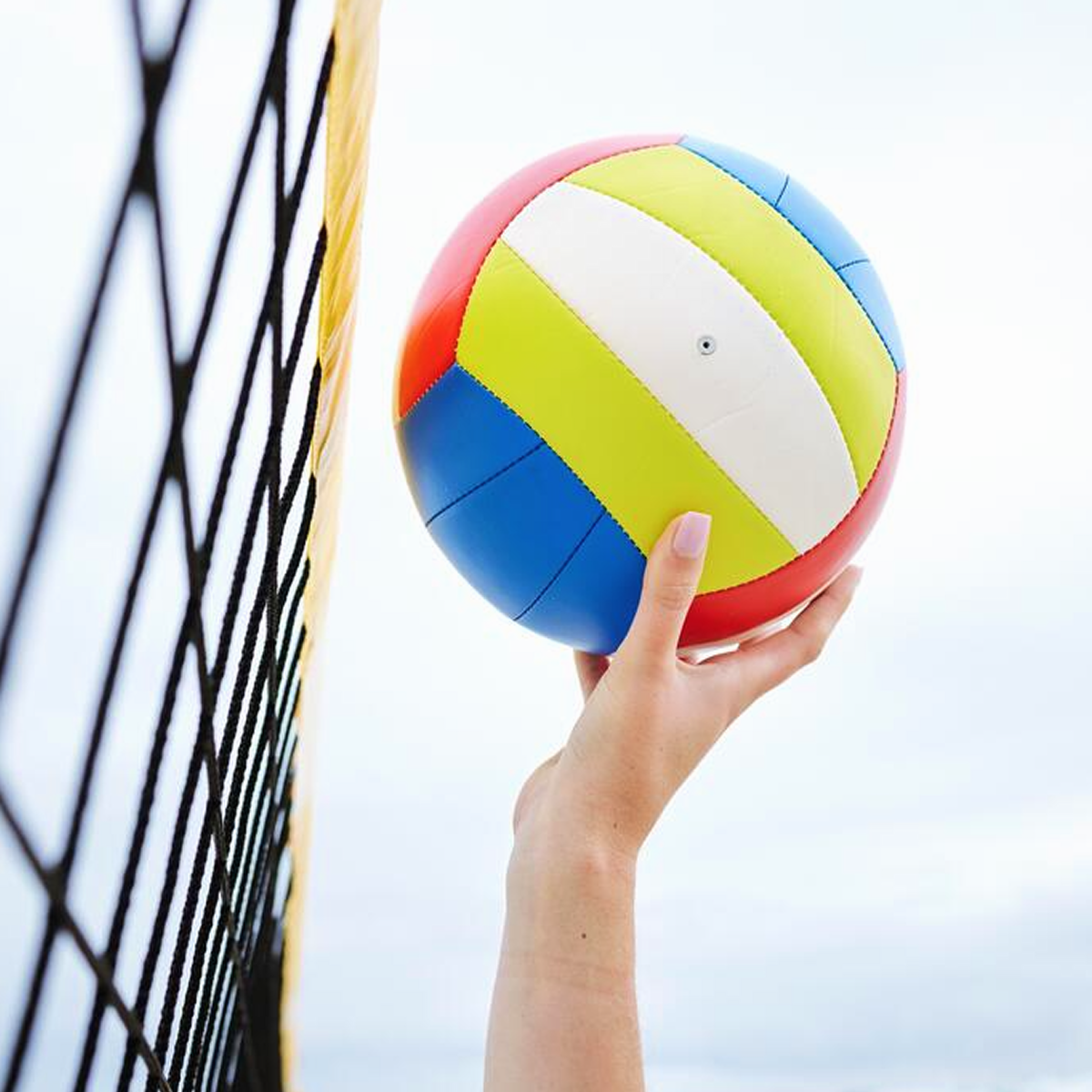
A volleyball net does more than divide the court. Its height determines how much clearance an attacker needs, while the tension of the upper cable affects how the ball reacts when it catches the tape. Antennas establish the limits of legal crossings, and even a small error in their placement can change an official’s decision.For competitive play, these measurements are not left to the equipment manufacturer or the venue. The FIVB specifies how high the net must stand, how it should be constructed, and where its supporting components belong. Schools and recreational leagues may use modified equipment, particularly for younger players, but the same basic principles apply.
Official Volleyball Net Height
Under the FIVB’s official volleyball net rules, height is measured at the center of the court. The net stands vertically above the center line, dividing a regulation indoor court into two 9 × 9 m halves.
The height above both sidelines must be equal and cannot exceed the prescribed measurement by more than 2 cm. This tolerance does not mean one end may be deliberately raised. The net should remain level, with its center at the required height.
Adult competition uses two standard measurements. Youth volleyball net height, however, depends on the age category and the organization responsible for the event.
Men’s and Women’s Volleyball
The official volleyball net height for senior indoor competition is:
| Competition | Net height | Imperial equivalent |
|---|---|---|
| Men’s volleyball | 2.43 m | 7 ft 11⅝ in |
| Women’s volleyball | 2.24 m | 7 ft 4⅛ in |
The men’s volleyball net height is 19 cm greater than the women’s volleyball net height. These measurements are used in international indoor competition and widely adopted by national federations.
That difference influences attacking and blocking. A higher net requires greater contact height to drive the ball sharply downward. An attacker who cannot reach far above the tape may need to rely more heavily on placement, changes of pace, and shots directed toward uncovered areas.
Blockers face a similar challenge. Reaching above the net is important, but hand positioning and timing often determine whether a block redirects the ball into the opponent’s court or merely slows the attack.
Height is only one factor. A well-timed approach and an accurate set can create better attacking opportunities than jumping higher with poor positioning.
Youth and Junior Volleyball
Junior competitions do not follow one universal net height. Age divisions, gender categories, and local regulations all influence the required measurement.
USA Volleyball provides a useful example of how junior indoor standards differ from senior competition.
| Junior category | Net height |
|---|---|
| Boys 15–18 | 2.43 m |
| Boys 13–14 | 2.24 m |
| Boys 12 and under | Depends on the specific division |
| Girls 15–18 | 2.24 m |
| Girls 13–14 | 2.24 m |
| Girls 12 and under | 2.13 m |
These are general age-group references rather than a complete reproduction of USA Volleyball’s junior regulations. Younger boys’ divisions, coed programs, and introductory competitions may have additional height requirements. The current event rules should be checked before installation.
Lowering the net for younger players serves a practical purpose. It allows them to practice attacking with appropriate arm mechanics rather than forcing every shot upward just to clear an adult-height net. Blocking also becomes more accessible while players develop coordination and jumping ability.
Some school programs make further adjustments for beginners. Those modified heights should not be confused with the standards used in sanctioned tournaments.
Standard Volleyball Net Dimensions
Net specifications extend beyond the height of the upper tape. Length, width, mesh openings, and reinforced bands all have prescribed measurements.
A regulation indoor net is 9.50 to 10 m long and 1 m wide, with a permitted width variation of 3 cm. Its black mesh consists of 10 × 10 cm square openings.
The standard volleyball net length exceeds the court’s 9 m width because the mesh must extend beyond both sidelines. The volleyball net width refers to its vertical depth, not the distance between the supporting posts.
| Component | Indoor standard |
|---|---|
| Net length | 9.50–10 m |
| Net width | 1 m ± 3 cm |
| Mesh openings | 10 × 10 cm |
| Upper band | 7 cm |
| Lower band | 5 cm |
| Side bands | 5 cm |
| Antenna length | 1.80 m |
Two vertical side bands are attached directly above the sidelines. These bands provide the mounting positions for the antennas and help identify the court’s lateral boundaries.
A beach volleyball net is shorter. Since the beach court measures 16 × 8 m, the net is 8.5 m long rather than the 9.50–10 m used indoors. Its nominal width remains 1 m.
The distinction matters when purchasing equipment. A recreational outdoor net may be suitable for casual play without meeting official beach volleyball specifications. Conversely, an indoor competition net is not automatically appropriate for a sand court.
Net Construction, Materials and Equipment
A net must hold its shape through repeated ball contact without losing tension. Its mesh, reinforced borders, and supporting cable work together to keep the playing surface consistent from one rally to the next.
Synthetic materials are widely used in modern volleyball equipment. Polyethylene and polypropylene are common in recreational nets because they resist moisture and require relatively little maintenance. Competition nets may use other durable synthetic fibers designed to withstand sustained tension.
Official specifications focus on the net’s construction and measurements rather than requiring one particular commercial material.
The upper white band of a regulation indoor net measures 7 cm in width. A flexible cable passes through it and connects to the tensioning system. The lower band is 5 cm wide and contains a cord that helps keep the mesh properly extended.
Supporting posts must also be positioned correctly. Under FIVB indoor rules, they stand 0.50 to 1.00 m outside the sidelines and measure 2.55 m in height. Adjustable posts are preferred because they allow the same court to accommodate different competition categories.
For FIVB World and Official Competitions, the posts are positioned 1 m outside the sidelines.
Safety deserves particular attention around the supports. Players regularly chase difficult passes toward the edges of the court, where exposed fittings or unstable posts create unnecessary risks. Padding, secure anchors, and properly installed tensioning mechanisms are essential.
Portable systems need the same care. A lightweight base may be convenient for storage, but it must remain stable when the net is fully tensioned.
How to Set Up a Volleyball Net Correctly
Before attaching the net, check the center line and post positions. If the supports are incorrectly placed, adjusting the cable will not correct the underlying alignment problem.
A reliable volleyball net setup follows a straightforward sequence:
- Inspect the supports. Confirm that the posts are stable, correctly spaced, and free from damaged fittings.
- Attach the upper cable. Secure it to the designated tensioning points without immediately applying full tension.
- Raise the net. Measure the required height from the playing surface at the center of the court.
- Adjust the cable tension. Remove excessive sagging without exceeding the manufacturer’s specified limits.
- Secure the lower cord. Keep the mesh evenly distributed and the side bands vertical.
- Install the antennas. Align each antenna with the outside edge of its corresponding side band above the sideline.
- Verify the measurements. Check the center height, both sidelines, and the stability of the entire installation.
The center measurement is particularly important. A net can appear level near the posts while hanging several centimeters too low in the middle.
Tension should be sufficient to maintain the required shape, not so high that the supports begin to bend. Overtightening can damage cables, fittings, or portable anchoring systems.
Some recreational nets settle after installation. Rechecking the height following warm-ups is a sensible precaution, especially when using equipment that is frequently assembled and dismantled.
The Role of Antennas and Boundary Markings
The two rods extending above the net establish the lateral limits of the crossing space. A ball traveling toward the opposing court normally must pass between them.
Each volleyball net antenna measures 1.80 m in length and approximately 10 mm in diameter. The upper 80 cm projects above the net and carries contrasting markings, usually alternating red and white stripes.
The antennas are attached to the outer edges of the side bands, directly above the sidelines.
A ball that touches an antenna is out. The same applies when an attack crosses completely outside one of the antennas, even if its trajectory would otherwise bring it down inside the opponent’s court.
There is a less obvious exception in indoor volleyball.
Suppose a team’s first contact sends the ball beyond the net through the external space outside an antenna. Under specific conditions, a player may chase it into the opponent’s free zone and return it through the external space on the same side, provided the team still has an available contact and the other requirements of the rule are satisfied.
This is not permission to attack directly into the opposing court outside the antenna. The recovery must follow the conditions established by the official rules.
Correct antenna placement is therefore essential for judging both ordinary attacks and unusual recovery situations.
Volleyball Net Rules During a Match
A ball striking the tape and a player touching the net are treated differently under the rules. The first may be completely legal; the second depends on where the contact occurs and whether the player is involved in an action of playing the ball.
Net Contact Violations
Under FIVB indoor rules, a player commits a fault by touching the net between the antennas during the action of playing the ball.
That action can include taking off, attempting to play the ball, making contact, and landing. The player does not need to touch the ball for the net contact to count as a violation.
Consider a middle blocker who jumps to stop an attack. If the blocker brushes the upper tape while landing as part of the blocking action, the referee calls a fault. An attacker who misses the ball but contacts the net during the attempted hit can also be penalized.
Other volleyball net violations include grabbing the mesh for support or interfering with an opponent’s legitimate attempt to play the ball.
Contact outside the antennas is treated differently. A player may touch the post, supporting ropes, or net outside the antenna without committing a fault, provided the contact does not interfere with play and no other rule is broken.
Ball Contact With the Net
A volleyball may touch the net during a serve and remain in play. If the ball clips the upper tape, crosses through the legal crossing space, and no other fault occurs, the serve is valid.
The same principle applies during a rally. An attack can strike the tape and drop into the opponent’s court. If it crosses legally and lands inbounds, the attacking team wins the rally.
A ball driven into the net may also be recovered before crossing.
For example, a team’s second contact might send the ball into the mesh instead of toward an attacker. A teammate can still use the third contact to return it over the net.
The rebound does not reset the team’s hit count. Indoor teams normally have three contacts to return the ball, excluding a block contact.
Indoor vs Beach Volleyball Nets
Indoor and beach volleyball use the same adult net heights, but their court dimensions and equipment requirements differ.
| Feature | Indoor volleyball | Beach volleyball |
|---|---|---|
| Court dimensions | 18 × 9 m | 16 × 8 m |
| Men’s net height | 2.43 m | 2.43 m |
| Women’s net height | 2.24 m | 2.24 m |
| Net length | 9.50–10 m | 8.50 m |
| Net width | 1 m ± 3 cm | 1 m ± 3 cm |
| Playing surface | Approved indoor flooring | Sand |
Outdoor conditions place additional demands on beach volleyball equipment. Wind can move loose mesh, while prolonged exposure to moisture and sunlight affects materials that are not designed for outdoor use.
Beach volleyball also has its own youth height standards. Under FIVB beach rules, the listed measurements are 2.24 m for players aged 16 and under, 2.12 m for 14 and under, and 2.00 m for 12 and under.
One practical difference between the disciplines concerns recovery outside the antenna. Indoor volleyball permits certain returns through the external space, as described earlier. Beach volleyball also recognizes external-space recovery, but the applicable conditions must be checked against its separate rulebook.
Another important difference is the number of permitted team contacts after a block. In indoor volleyball, a block contact does not count as one of the team’s three hits. In beach volleyball, a block generally counts as the first team contact, leaving two additional contacts to return the ball.
Although that distinction concerns ball handling rather than the physical net, it directly affects rallies involving blocks at the tape.
Common Net Setup Mistakes
A regulation net can still sit too low, lean to one side, or leave the antennas out of position. These problems are usually caused by installation rather than faulty equipment.
Measuring height only near the posts is one of the most common mistakes. The cable may be correctly positioned at both ends while the middle hangs below regulation height. A measuring rod at the center reveals the discrepancy.
Uneven tension creates a different problem. If one side pulls harder than the other, the mesh may shift and the side bands may no longer sit directly above the sidelines.
The lower cord also needs attention. When left loose, the mesh can bunch or move unevenly during play. Tightening it excessively, however, may distort the net’s shape.
Poorly secured portable bases present a more serious concern. A net that shifts during a rally is inconvenient, but an unstable support can become dangerous when players move toward it.
Damaged mesh, worn cables, and inadequate post padding should be addressed before the match begins.
A final inspection should confirm the net’s height, alignment, tension, and overall stability. These checks take little time compared with the disruption caused by an equipment problem once play has started.
FAQ
What is the official volleyball net height for men and women?
The official indoor volleyball net height is 2.43 m for men and 2.24 m for women. The same adult measurements apply to beach volleyball under FIVB rules.
What are the standard volleyball net dimensions?
A regulation indoor volleyball net measures 9.50 to 10 m long and approximately 1 m wide. Its mesh openings are 10 × 10 cm. Beach volleyball uses a shorter net measuring 8.5 m in length.
Can a volleyball touch the net during a serve?
Yes. A serve remains legal if the ball touches the net and crosses into the opponent’s court through the permitted crossing space without another fault.
Is touching the net always a violation?
No. In indoor volleyball, net contact between the antennas during the action of playing the ball is a fault. Certain contacts outside the antennas are permitted if they do not interfere with play.
Can an indoor volleyball net be used for beach volleyball?
Not for regulation competition unless the equipment meets the applicable beach volleyball specifications. The courts have different widths, and official beach nets are shorter. Recreational games may use more flexible equipment standards.