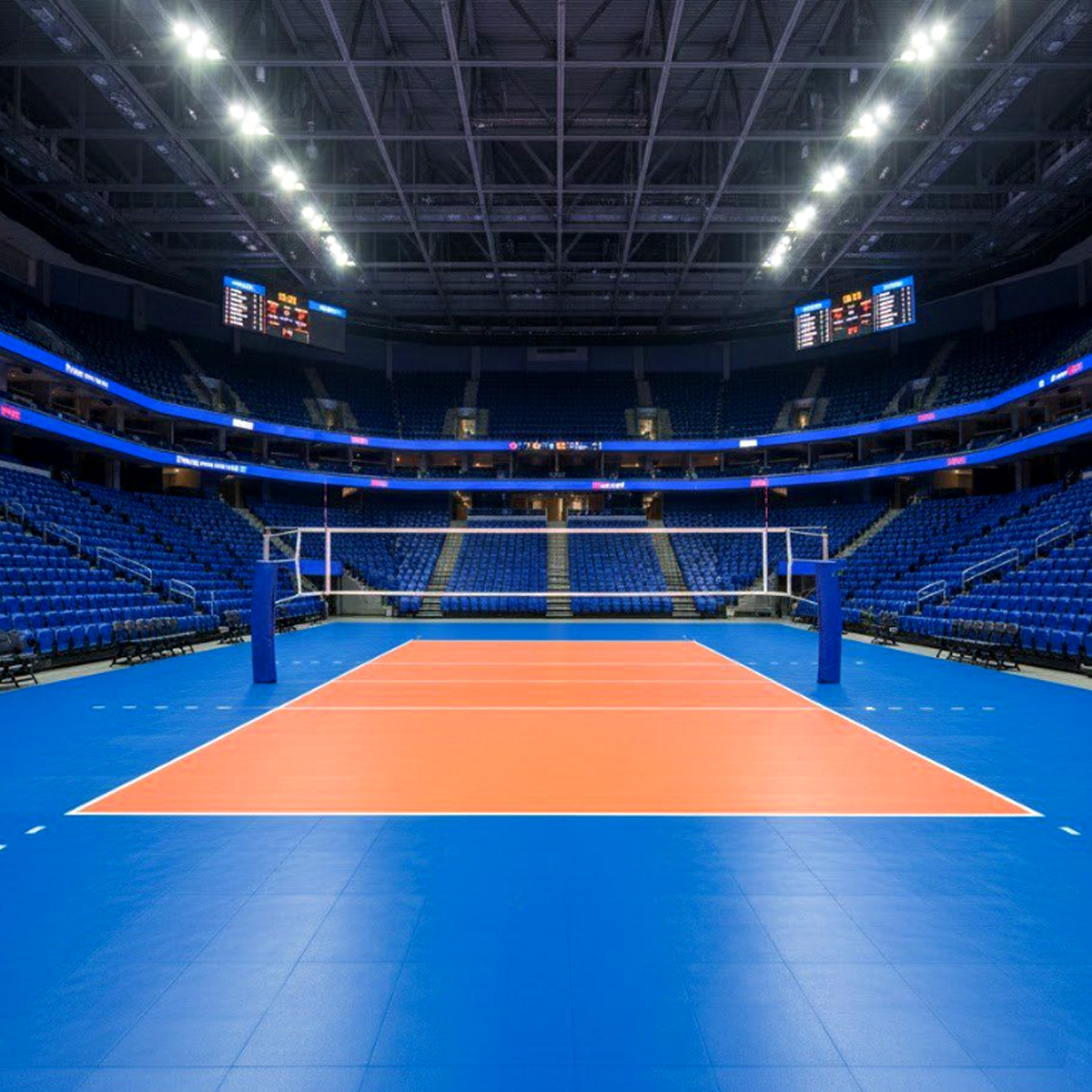
A volleyball court looks simple enough until a rally sends the ball beyond its boundaries. A defender may chase a deflection several meters past the sideline, while a back-row attacker must judge exactly where to take off before hitting the ball. Both situations depend on the court’s layout, although the rules governing them are different.The markings determine more than whether a ball lands in or out. They establish where serves originate, which attacking restrictions apply, and how players can move around the net. Even the space outside the painted rectangle has a purpose.
Under FIVB regulations, a standard indoor volleyball court measures 18 meters long and 9 meters wide. Beach volleyball uses a smaller playing area, with different markings and positional rules. Those differences help explain how court design affects each version of the sport.
Standard Volleyball Court Dimensions
The official indoor volleyball court size is 18 × 9 meters (approximately 59 ft 1 in × 29 ft 6 in). The net divides the rectangle into two equal 9 × 9-meter halves. Each team occupies 81 square meters, giving the entire volleyball playing area a total of 162 square meters.
These measurements apply to regulation six-player volleyball. Youth leagues and recreational programs sometimes use smaller courts, but those adjustments depend on the competition rather than standard FIVB specifications.
| Measurement | Regulation indoor court |
| Total length | 18 m (59 ft 1 in) |
| Total width | 9 m (29 ft 6 in) |
| Each team’s half | 9 × 9 m |
| Total court area | 162 m² |
| Attack line distance | 3 m (9 ft 10 in) |
| Minimum free zone | 3 m on every side |
| Minimum overhead clearance | 7 m |
| Boundary line width | 5 cm |
The marked rectangle is only part of the required space. FIVB regulations specify a free zone extending at least 3 meters beyond each sideline and end line. Including this area, the minimum playing footprint measures 24 × 15 meters.
International competitions need more room. For FIVB World and Official Competitions, the free zone extends 5 meters beyond the sidelines and 6.5 meters beyond the end lines, producing an overall footprint of 31 × 19 meters. The required overhead clearance also increases from 7 to 12.5 meters.
That extra space can influence a rally. A ball deflected off a block may travel beyond the sidelines without touching the floor. In a cramped gym, a defender might run out of room before reaching it. A larger free zone allows more opportunities for recovery.
Understanding the Volleyball Court Layout
A volleyball court layout consists of several areas with different functions. The center line divides the teams’ halves, while the attack lines separate the front zones from the backcourt. Service zones extend behind the end lines.
These divisions do not prevent players from moving around the court. Instead, they determine whether particular actions are legal. A back-row player, for example, may approach the net to set the ball but faces restrictions when completing an attack above net height.
A standard volleyball court diagram shows the net, center line, attack lines, sidelines, and end lines. Their positions remain fixed even as players change formations during a rally.
Front Zone and Back Zone
Each team’s front zone extends from the axis of the center line to the rear edge of the attack line, located exactly 3 meters away.
The remaining area toward the end line is commonly called the backcourt or back zone. Players frequently receive serves, defend attacks, and begin attacking approaches from this part of the court.
The three-meter line becomes important when a back-row player attacks a ball entirely above the net. To complete that attack legally from outside the front zone, the player must take off without touching or crossing the attack line. Landing inside the front zone afterward is permitted.
Consider an attacker approaching from position 1. The player can jump from behind the line, strike the ball above net height, and land closer to the net. If the takeoff foot touches the line, however, completing that attack constitutes a fault.
A back-row player may attack from within the front zone when the ball is not entirely above the top of the net at contact. Simply entering the area or jumping there is not a violation.
The front zone also extends laterally beyond the sidelines to the end of the free zone. Approaching from outside the painted court therefore does not remove the three-meter restriction.
Service Zone and Free Zone
The volleyball service zone lies behind each end line. It extends across the full 9-meter width of the court and backward to the limit of the free zone. Two short markings identify its lateral boundaries.
Servers can choose different starting positions within this area. Serving near a corner, for instance, changes the angle toward the receiving team and may help target a particular passing lane.
At the service hit, or during takeoff for a jump serve, the player must not touch the end line, the playing court, or the surface outside the service zone. After contacting the ball, the server may land inside the court or outside the service zone.
The surrounding free zone allows players to pursue balls traveling beyond the boundaries. A defender can run past a sideline to recover a deflection without automatically committing a fault. Whether the ball remains playable depends on its trajectory, the available team contacts, and the rules governing its return.
Volleyball Court Lines and Markings
Not every marking serves the same purpose. Boundary lines determine whether a ball lands in or out. The center line regulates certain movements beneath the net, while attack lines establish restrictions on back-row attacks.
Official volleyball court markings are 5 centimeters wide and must contrast with the playing surface. Visibility matters when a referee must judge a close landing or an attacker’s takeoff position.
Center Line and Attack Line
The volleyball center line runs directly beneath the net between the sidelines. Its axis divides the court into equal halves, although the entire width of the line belongs equally to both courts.
Crossing it is not automatically a fault. Under indoor rules, a player may touch the opponent’s court with a foot if some part of that foot remains in contact with or directly above the center line and the movement does not interfere with an opponent.
Complete penetration with a foot into the opponent’s court is a fault. Contact by another body part may be permitted when it does not interfere with play.
The volleyball attack line runs parallel to the center line on each side. Its rear edge is positioned 3 meters from the center line’s axis.
For FIVB World and Official Competitions, the line continues beyond each sideline through five separated segments. Each measures 15 centimeters, with 20-centimeter gaps between them. These extensions help officials assess attacks initiated outside the court’s lateral boundaries.
Sidelines and End Lines
Two sidelines form the longer boundaries, while two end lines close the shorter sides. All four belong to the playing court.
A ball is in when any part of its contact with the floor touches a boundary line. It does not need to land completely inside the rectangle.
Close decisions can be difficult when a powerful attack strikes near a corner. The ball deforms on impact, and its visible position immediately before landing may not reveal the precise contact area.
End lines have another function during service. A server touching the end line at the prohibited moment commits a fault, even though that same line counts as part of the court when judging a ball’s landing.
How Player Positions Relate to Court Zones
Six-player volleyball uses three front-row and three back-row positions. Each has a number, but these positions should not be confused with permanent locations throughout a rally.
The standard rotational arrangement, viewed from one team’s side, is:
| Left | Middle | Right |
| Position 4: Left front | Position 3: Middle front | Position 2: Right front |
| Position 5: Left back | Position 6: Middle back | Position 1: Right back |
The net is above the front-row positions, with the end line behind positions 5, 6, and 1.
When a team wins the right to serve after receiving, its players rotate clockwise. The player in position 2 moves to position 1 to serve.
The volleyball front row consists of positions 4, 3, and 2. These players may attack above net height from the front zone and participate in blocking.
The volleyball back row includes positions 5, 6, and 1. Back-row players cannot complete a block or participate in a completed collective block. They also face restrictions on attacks initiated from the front zone.
Setters illustrate how rotational status affects tactics. A back-row setter can move toward the net and deliver a set. Setting itself is legal, but completing an attack from the front zone while the ball is entirely above net height would violate the back-row restrictions.
Under current FIVB indoor rules, the receiving team must maintain its required rotational positions at the service hit. Players on the serving team may occupy any positions within their own court, provided the correct player serves.
After the serve, players can move into their preferred tactical formations. This allows teams to organize blocking, setting, and defensive coverage without changing their rotational status.
Indoor Volleyball vs Beach Volleyball Court Dimensions
A beach volleyball court measures 16 × 8 meters, compared with the 18 × 9-meter indoor layout. Each beach team defends 64 square meters, while an indoor team occupies 81 square meters.
The difference becomes more interesting when player numbers are considered. Indoor volleyball uses six players per team, whereas standard beach volleyball uses two. Despite the smaller court, each beach player must cover a substantially larger share of the playing area.
| Feature | Indoor volleyball | Beach volleyball |
| Court length | 18 m | 16 m |
| Court width | 9 m | 8 m |
| Total area | 162 m² | 128 m² |
| Players per team | 6 | 2 |
| Attack line | 3 m from center | None |
| Center line | Yes | None |
| Surface | Approved indoor flooring | Sand |
| Minimum free zone | 3 m | 3 m |
Beach volleyball has no attack line and does not distinguish between front-row and back-row players. Both players may attack from anywhere on their side, subject to the discipline’s rules on attacking contacts.
There is also no painted center line beneath the net. Players may enter the opponent’s court or free zone if they do not interfere with the opponent’s play.
Beach volleyball court boundaries use flexible, contrasting ribbons secured with suitable anchors. Unlike painted markings, these can accommodate movement in the sand.
Adult net heights remain identical in both disciplines: 2.43 meters for men and 2.24 meters for women.
For FIVB World and Official Beach Volleyball Competitions, the surrounding free zone must extend 5 to 6 meters, with at least 12.5 meters of unobstructed vertical clearance.
Court Surface and Playing Conditions
Correct dimensions mean little if the surface makes ordinary movement unsafe. Volleyball involves repeated changes of direction, sudden stops, jumps, and landings. The floor must accommodate those movements without creating unnecessary hazards.
Indoor courts generally use wooden or synthetic flooring. For FIVB World and Official Competitions, the surface must meet the relevant approval requirements.
The floor must be flat, horizontal, and uniform. Loose sections, uneven joints, or slippery patches can interfere with footwork, particularly when players land from a block or change direction to recover a deflection.
Color contrast also matters. For FIVB international competitions, the playing court and free zone must have different colors, with white boundary markings.
Beach courts require different preparation. The sand should be level, reasonably uniform, and free of stones, shells, or other objects capable of causing injury. For FIVB World and Official Competitions, the sand must be at least 40 centimeters deep.
Sand quality influences movement and landing conditions. Coarse material can cause abrasions, while heavily compacted areas may make jumping and diving uncomfortable.
Lighting deserves attention as well. Players regularly look upward to track high passes and serves. Poorly positioned fixtures or strong glare can make following the ball more difficult.
The surrounding area must also remain clear of equipment, exposed supports, and other obstacles that could interfere with players pursuing the ball.
How to Measure and Mark a Volleyball Court
Accurate volleyball court measurements begin with the outer rectangle. Once its dimensions are established, the center line, attack lines, and service markings can be positioned relative to the boundaries.
A measuring tape, straightedge, suitable marking tool, and reliable method of checking right angles are sufficient for planning the layout.
To mark a regulation indoor court:
- Establish the rectangle. Measure 18 meters along the length and 9 meters across the width. Check that opposite sides are parallel and the corners form right angles.
- Verify the diagonals. Each should measure approximately 20.12 meters. Compare both measurements while confirming the side lengths.
- Mark the center line. Locate the midpoint of the court’s length and draw a line perpendicular to the sidelines.
- Position the attack lines. Measure 3 meters from the center line’s axis to the rear edge of each attack line.
- Complete the boundaries. Apply the sidelines and end lines at the required width of 5 centimeters, ensuring the finished court retains its official dimensions.
- Add service-zone markings. Place two 15-centimeter lines behind each end line, 20 centimeters back and aligned as extensions of the sidelines.
- Inspect the surrounding space. Confirm that the free zone and overhead clearance meet the intended competition’s requirements.
Diagonal measurements are particularly useful. A quadrilateral can have the correct side lengths without forming a rectangle. Comparing both diagonals helps reveal such errors.
Line placement requires similar precision. The official 18 × 9-meter dimensions include the boundary lines. Placing them entirely outside the measured rectangle would increase the finished court size.
Net posts must also be positioned correctly. Under standard FIVB specifications, they stand 0.50 to 1.00 meters outside the sidelines, with additional requirements for certain international competitions.
Before play begins, inspect the surface, markings, net system, and surrounding area. Accurate dimensions do not compensate for unsafe conditions.
Common Questions About Court Boundaries and Rules
Some court-related decisions involve more than where the ball lands. The net, antennas, and surrounding free space can determine whether a rally continues.
Consider a ball crossing outside an antenna. Under specific indoor volleyball rules, a ball traveling into the opponent’s free zone through the external space may still be recovered by the team that played it. The return must follow the permitted path and satisfy the other conditions governing such recoveries.
The antennas establish the lateral limits of the legal crossing space above the net. A ball touching an antenna is out, even if its trajectory might otherwise have brought it into the opponent’s court.
Players must also distinguish between touching the net and moving beneath it. Contact with the net between the antennas during the action of playing the ball is a fault. Movement beneath the net is judged separately, including whether it interferes with an opponent.
These decisions depend on the ball’s trajectory, the player’s actions, and the specific rule involved. The painted boundaries alone do not settle every situation.
FAQ
What are the official dimensions of a volleyball court?
A regulation indoor volleyball court measures 18 × 9 meters, divided into two 9 × 9-meter halves. The total playing area is 162 square meters, with a surrounding free zone of at least 3 meters under standard FIVB rules.
How far is the attack line from the net in volleyball?
The attack line is positioned 3 meters from the axis of the center line beneath the net, measured to its rear edge. It establishes the front zone and affects attacks completed by back-row players.
Are volleyball court lines considered in or out?
Boundary lines belong to the playing court. If any part of the ball’s contact with the floor touches a sideline or end line, the ball is in. A ball landing completely beyond those markings is out.
What is the difference between indoor and beach volleyball court sizes?
Indoor volleyball uses an 18 × 9-meter court, while beach volleyball uses a 16 × 8-meter court. Beach volleyball also has no attack line or center line and is played on sand.
Can a volleyball player step outside the court during a rally?
Yes. Players may leave the marked court to recover a ball, provided the recovery complies with the rules. Entering the free zone does not automatically end a rally.